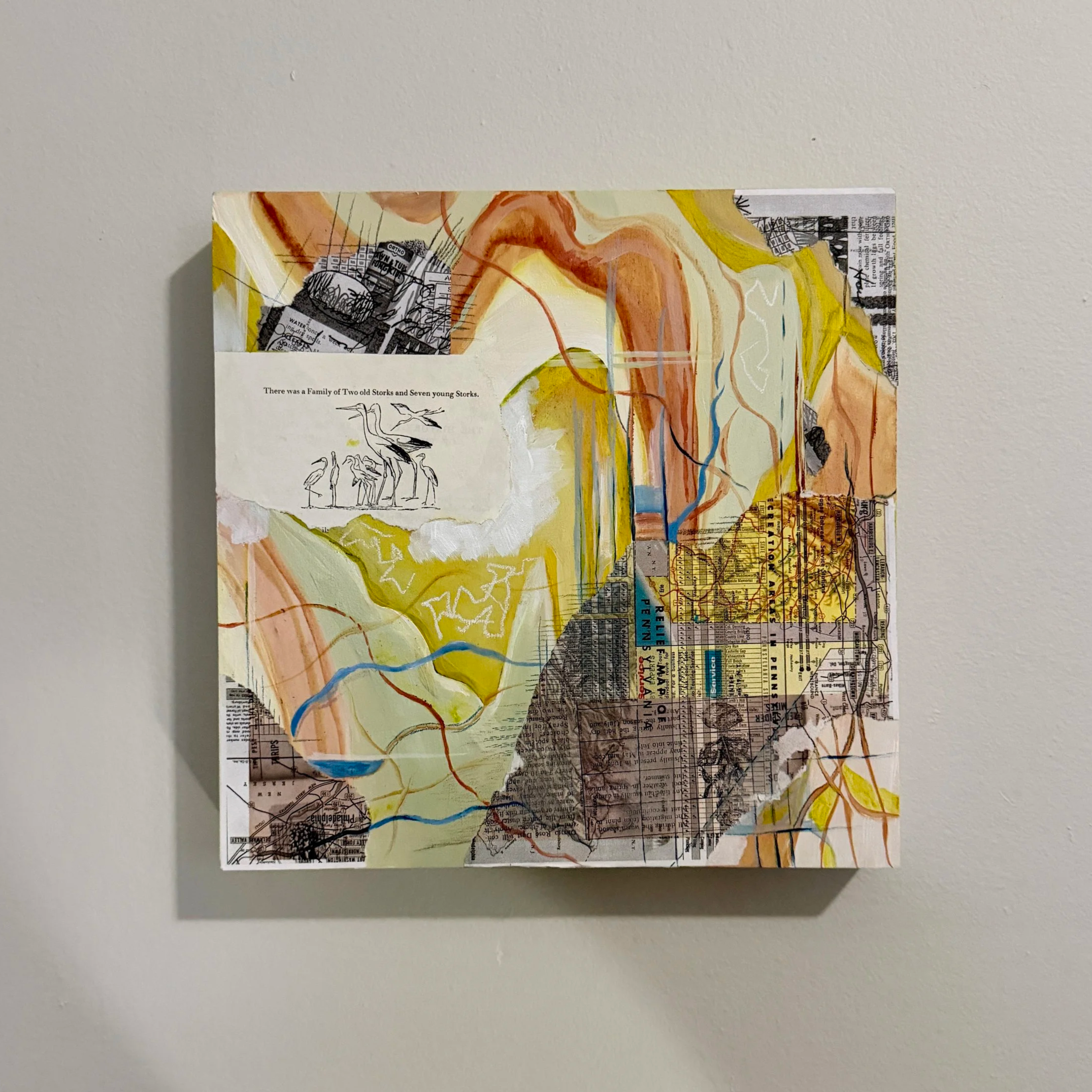
Map Quest(s), 12 x 12 in, acrylic and collage on wood panel
I often define my practice as an ongoing process of observing the world around me and creating work that helps me process my place within it. As I transition between different roles: student, educator, artist, and now gearing up for grad school; I’ve become increasingly aware of the many systems I move through and the ways they shape both individual experience and collective responsibility. Lately I’ve been thinking about systems as a whole. The interconnected structures that shape nearly every aspect of our lives. Our bodies, waterways, highways, food supply, education, media, and ecosystems all function as networks of individual parts working together to form something larger than themselves.
Questions surrounding climate change and environmental stewardship are part of this reflection, not because I believe awareness alone is enough, but because I am interested in what it means to exist within systems that are far larger than any one person. My material choices reinforce these ideas. I work with found maps, vintage magazines, book pages, and other printed matter; objects that all originate from different systems of knowledge often discarded and ready to be repurposed into something new. Removed from their original purposes and layered together, these materials begin to form new relationships. Just as no system exists in isolation, neither do these fragments. Through collage, print, and painting, I build a visual network where disparate pieces interact, overlap, and become part of something larger than their individual histories.
Maps became a natural visual language for exploring these ideas. They describe relationships rather than destinations. Layering altered materials through scanning, printing, painting, drawing, and collage allow me to think through the visible and invisible systems that organize the world we live in today. I utilize landscape-esque compositions to put the focus back onto the natural world in hopes that the viewer may begin to question their own place in “The System.”